
《自然》一周论文导读冯维维
Nature, 15 January 2026,Volume 649 Issue 8097
《自然》,2026年1月15日,第649卷,8097期
物理学Physics
Little red dots as young supermassive black holes in dense ionized cocoons
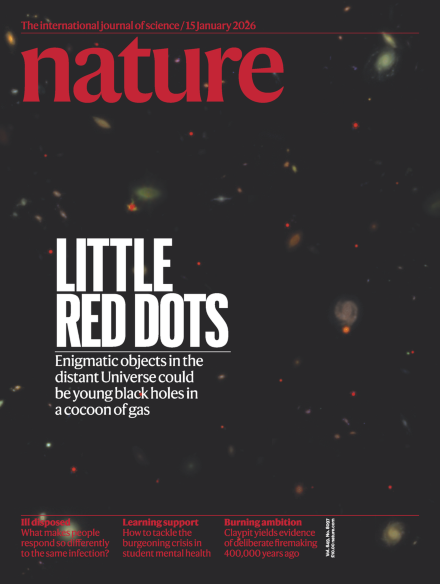
神秘“小红点”可能是黑洞
▲ 作者:V. Rusakov, D. Watson, G. P. Nikopoulos, G. Brammer, R. Gottumukkala, T. Harvey, K. E. Heintz, R. Damgaard, S. A. Sim, A. Sneppen, A. P. Vijayan, N. Adams, D. Austin, C. J. Conselice, C. M. Goolsby, S. Toft & J. Witstok
https://www.nature.com/articles/s41586-025-09900-4
英国科学家发表了对詹姆斯·韦布太空望远镜数据的一项分析,认为遥远星系里一群被称为“小红点”的神秘天体,可能是被中性气体和电子云遮盖的年轻超大质量黑洞。这一发现揭示了此前未知的早期宇宙中黑洞的发展阶段。
天文学家一直在争论韦布望远镜早期实验中发现的一组“小红点”的身份。这些红点被认为是超大质量黑洞或者恒星形成的迹象,但其行为不完全符合二者特征。
曼彻斯特大学的Vadim Rusakov和同事分析了12个单独研究的星系的数据,结合其他18个星系的数据,来更好地理解“小红点”随时间的变化规律。
通过研究这些星系中心的发射光谱,他们发现这些光谱源于光子在围绕黑洞的星系中心致密气体云中与电子散射产生的现象。作者计算出这些黑洞的体积可能比此前估计的小100倍。他们还认为,这些较小的黑洞被高密度气体茧包裹,该结构可能是其辐射的主要来源。
研究者认为,这些黑洞处在发展早期阶段,它们被高密度物质包围,阻隔了X射线和无线电波,光线被重塑成特定的模式。某些细节(如X射线为何如此微弱)仍需进一步研究。未来的观察将致力于探索这一“茧期”是否普遍存在,以及它将如何影响黑洞和星系的发展。
▲ Abstract:
The James Webb Space Telescope (JWST) has uncovered many compact galaxies at high redshift with broad hydrogen and helium lines, including the enigmatic population of little red dots (LRDs). The nature of these galaxies is debated and is attributed to supermassive black holes (SMBHs) or intense star formation5. They exhibit unusual properties for SMBHs, such as black holes that are overmassive for their host galaxies4 and extremely weak X-ray and radio emission. Here we show that in most objects studied with the highest-quality JWST spectra, the lines are broadened by electron scattering with a narrow intrinsic core. The data require very high electron column densities and compact sizes (light days), which, when coupled with their high luminosities, can be explained only by SMBH accretion. The narrow intrinsic line cores imply black hole masses of 105?7M⊙, two orders of magnitude lower than previous estimates. These are the lowest mass black holes known at high redshift, to our knowledge, and suggest a population of young SMBHs. They are enshrouded in a dense cocoon of ionized gas producing broad lines from which they are accreting close to the Eddington limit, with very mild neutral outflows. Reprocessed nebular emission from this cocoon dominates the optical spectrum, explaining most LRD spectral characteristics, including the weak radio and X-ray emission.
宇宙演化早期科学观测计划图 图源:CEERS
Coherent nonlinear X-ray four-photon interaction with core-shell electrons
基于芯—壳电子的相干非线性X射线四光子相互作用
▲ 作者:Ana Sofia Morillo-Candas, Sven Augustin, Eduard Prat, Antoine Sarracini, Jonas Knurr, Serhane Zerdane, Zhibin Sun, Ningchen Yang, Marc Rebholz, Hankai Zhang, Yunpei Deng, Xinhua Xie, Elnaz Zyaee, David Rohrbach, Andrea Cannizzo, Andre Al-Haddad, Kirsten Schnorr, Christian Ott, Thomas Feurer, Christoph Bostedt, Thomas Pfeifer & Gregor Knopp
https://www.nature.com/articles/s41586-025-09911-1
相干非线性X射线光与物质的相互作用为超快光谱学开启了一个新领域,使得原子级空间分辨率与飞秒至阿秒级时间分辨率得以结合。研究者利用自由电子激光产生的宽带单X射线脉冲,演示了与芯壳电子的相干、无背景四光子相互作用。
在气态氖中测量的全X射线四波混频信号,源自包含拉曼跃迁的双共振非线性过程,其中包括X射线相干反斯托克斯电子拉曼散射。所获得的二维光谱映射(入射光子/出射光子)标志着向原子尺度多维关联光谱学迈进了一步。
通过采用多色延时X射线脉冲方案,研究者进一步证明了将所提方法扩展到超快时间域的可行性。这些结果揭示了该方法在研究从生物分子到关联量子材料等多种体系中局域电子动力学的潜力,其应用可涵盖能量转换、生物医学成像和量子信息技术等领域。
▲ Abstract:
Coherent nonlinear light–matter interaction with X-rays gives access to a regime in ultrafast spectroscopy in which atomic resolution meets femtosecond and attosecond timescales.Here we demonstrate coherent, background-free four-photon interactions with core-shell electrons using single broadband X-ray pulses from a free-electron laser. The all-X-ray four-wave mixing signals, measured in gaseous neon, arise from doubly resonant nonlinear processes involving Raman transitions6, including X-ray coherent anti-Stokes electronic Raman scattering. The 2D spectral maps (photon-in/photon-out) represent a step towards multidimensional correlation spectroscopy at the atomic scale. Using a multicolour time-delayed X-ray pulse scheme, we further demonstrate the feasibility of extending the proposed methodology to the ultrafast time domain. These results reveal potential for studying localized electron dynamics in multiple systems, from biomolecules to correlated quantum materials, with applications in areas such as energy conversion, biomedical imaging and quantum information technologies.
Exciplex-enabled high-efficiency, fully stretchable OLEDs
基于激基复合物的高效率全拉伸型OLED
▲ 作者:Huanyu Zhou, Hyun-Wook Kim, Shin Jung Han, Danzhen Zhang, Woo Jin Jeong, Haomiao Yu, Youichi Tsuchiya, Bin Hu, June Huh, Teng Zhang, Seungyeon Cho, Joo Sung Kim, Dong-Hyeok Kim, Hyung Joong Yun, Jinwoo Park, Kyung Yeon Jang, Eojin Yoon, Amit Kumar Harit, Min-Jun Sung, Yooseong Ahn, Hao Chen, Qingsen Zeng, Chan-Yul Park, Kwan-Nyeong Kim, Tae-Woo Lee, etc.
https://www.nature.com/articles/s41586-025-09904-0
全拉伸型有机发光二极管(OLED)完全由本征可拉伸材料构成,是用于皮肤表面显示器的关键元件。然而,其器件效率低下一直是十余年来阻碍实际应用的持久瓶颈。
研究者通过引入一种本征可拉伸的激基复合物辅助磷光层应对了这一挑战。其弹性体耐受的三重态循环机制缓解了由绝缘弹性体基质引起的激子能量转移限制,从而制备出发光层拉伸率超过200%、外量子效率达21.7%的材料。
为将这一性能转化为全拉伸型器件,研究者集成了MXene接触式可拉伸电极,该电极具有高机械鲁棒性和可调控的功函数,确保了高效的空穴和电子注入。这些进展使得全拉伸型OLED实现了17.0%的创纪录外量子效率,并在60%应变下仅有极小的发光损失。这种高效率、机械适应性强的光电器件设计方法将推动下一代可穿戴与可变形显示器的发展。
▲ Abstract:
Fully stretchable organic light-emitting diodes (OLEDs), composed entirely of intrinsically stretchable materials, are essential for on-skin displays. However, their low device efficiency has been a persistent barrier to practical applications for more than a decade. Here we addressed this challenge by incorporating an intrinsically stretchable exciplex-assisted phosphorescent (ExciPh) layer. The elastomer-tolerant triplet-recycling mechanism mitigates exciton energy transfer limitations arising from the insulating elastomer matrix, yielding a light-emitting layer with more than 200% stretchability and an external quantum efficiency (EQE) of 21.7%. To translate this performance to fully stretchable devices, we integrated MXene-contact stretchable electrodes (MCSEs), which feature high mechanical robustness and tunable work function (WF), ensuring efficient hole and electron injection. These advances enable fully stretchable OLEDs with a record EQE of 17.0% and minimal luminescence loss under 60% strain. This approach to designing high-efficiency, mechanically compliant optoelectronics will enable the next-generation wearable and deformable displays.